American environmentalist
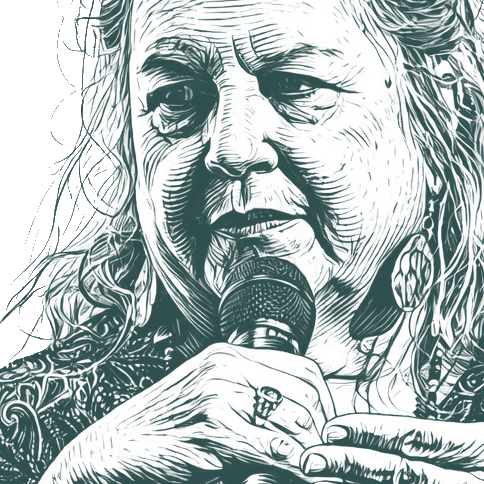
Robin Wall Kimmerer (born September 13, 1953) is an enrolled member of the Citizen Potawatomi Nation who is the Distinguished Teaching Professor of Environmental and Forest Biology; and Director, Center for Native Peoples and the Environment, at the State University of New York College of Environmental Science and Forestry (SUNY-ESF). She is the author of numerous scientific articles, and the books Gathering Moss: A Natural and Cultural History of Mosses (2003), and Braiding Sweetgrass: Indigenous Wisdom, Scientific Knowledge and the Teachings of Plants (2013).
Bio from: Wikiquote (CC BY-SA 4.0) · Portrait adapted from: Wikimedia Commons, Indiana Humanities (CC BY-SA)
From Wikidata (CC0)
"There is an ancient conversation going on between mosses and rocks, poetry to be sure. About light and shadow and the drift of continents. This is what has been called the "dialect of moss on stone - an interface of immensity and minute ness, of past and present, softness and hardness, stillness and vibrancy, yin and yan.
The waste beds continue to leach tons of salt into the lake every year. Before the Allied Chemical Company, successor to Solvay Process, ceased operation, the salinity of Onondaga Lake was ten times the salinity of the headwaters of Nine Mile Creek. The salt, the oncolites, and the waste impede the growth of rooted aquatic plants. Lakes rely on their submerged plants to generate oxygen by photosynthesis. Without plants, the depths of Onondaga Lake are oxygen-poor, and without swaying beds of vegetation, fish, frogs, insects, herons—the whole food chain—are left without habitat. While rooted water plants have a hard time, floating algae flourish in Onondaga Lake. For decades high quantities of nitrogen and phosphorous from municipal sewage fertilized the lake and fueled their growth. Algae blooms cover the surface of the water, then die and sink to the bottom. Their decay depletes what little oxygen is in the water and the lake begins to smell of the dead fish that wash up on shore on hot summer days.
The federal government's Indian Removal policies wrenched many Native peoples from our homelands. It separated us from our traditional knowledge and lifeways, the bones of our ancestors, our sustaining plants—but even this did not extinguish identity. So the government tried a new tool, separating children from their families and cultures, sending them far away to school, long enough, they hoped, to make them forget who they were. [...] Children, language, lands: almost everything was stripped away, stolen when you weren't looking because you were trying to stay alive. In the face of such loss, one thing our people could not surrender was the meaning of land. In the settler mind, land was property, real estate, capital, or natural resources. But to our people, it was everything: identity, the connection to our ancestors, the home of our nonhuman kinfolk, our pharmacy, our library, the source of all that sustained us. Our lands were where our responsibility to the world was enacted, sacred ground. It belonged to itself; it was a gift, not a commodity, so it could never be bought or sold. These are the meanings people took with them when they were forced from their ancient homelands to new places. Whether it was their homeland or the new land forced upon them, land held in common gave people strength; it gave them something to fight for. And so—in the eyes of the federal government—that belief was a threat.
In an essay describing peoples with few possessions as the original affluent society, anthropologist reminds us that, "modern capitalist societies, however richly endowed, dedicate themselves to the proposition of scarcity. Inadequacy of economic means is the first principle of the world’s wealthiest peoples." The shortage is due not to how much material wealth there actually is, but to the way in which it is exchanged or circulated. The artificially creates scarcity by blocking the flow between the source and the consumer. Grain may rot in the warehouse while hungry people starve because they cannot pay for it. The result is famine for some and diseases of excess for others. The very earth that sustains us is being destroyed to fuel injustice. An economy that grants personhood to corporations but denies it to the more-than-human beings: this is a economy.
Our stories say that of all the plants, wiingaashk, or sweetgrass, was the very first to grow on the earth, its fragrance a sweet memory of Skywoman’s hand. Accordingly, it is honored as one of the four sacred plants of my people. Breathe in its scent and you start to remember things you didn’t know you’d forgotten. Our elders say that ceremonies are the way we “remember to remember
It is the fundamental unfairness of parenthood that if we do our jobs well, the deepest bond we are given will walk out the door with a wave over the shoulder. We get good training along the way. We learn to say "Have a great time, sweetie" while we are longing to pull them back to safety. And against all the evolutionary imperatives of protecting our gene pool, we give them car keys. And freedom. It's our job. And I wanted to be a good mother.
Try QuoteGPT
Chat naturally about what you need. Each answer links back to real quotes with citations.
It is said that the Creator gathered together the four sacred elements and breathed life into them to give form to Original Man before setting him upon Turtle Island. The last of all beings to be created, First Man was given the name . The Creator called out the name to the four directions so that the others would know who was coming. Nanabozho, part man, part manido—a powerful spiritbeing—is the personification of life forces, the , and our great teacher of how to be human. In Nanabozho's form as Original Man and in our own, we humans are the newest arrivals on earth, the youngsters, just learning to find our way.