So I withdrew and thought to myself: 'I am wiser than this man; it is likely that neither of us knows anything worthwhile, but he thinks he knows something when he does not, whereas when I do not know, neither do I think I know; so I am likely to be wiser than he to this small extent, that I do not think I know what I do not know.
5th-century BCE Greek philosopher
Socrates (Σωκράτης; c. 470 BC – 399 BC) was a classical Greek (Athenian) philosopher credited as one of the founders of Western philosophy. Through his portrayal in Plato's dialogues, Socrates has become renowned for his contribution to the field of ethics, and it is this Platonic Socrates who lends his name to the concepts of Socratic irony and the Socratic method, or elenchus. The latter remains a commonly used tool in a wide range of discussions, and is a type of pedagogy in which a series of questions is asked not only to draw individual answers, but also to encourage fundamental insight into the issue at hand.
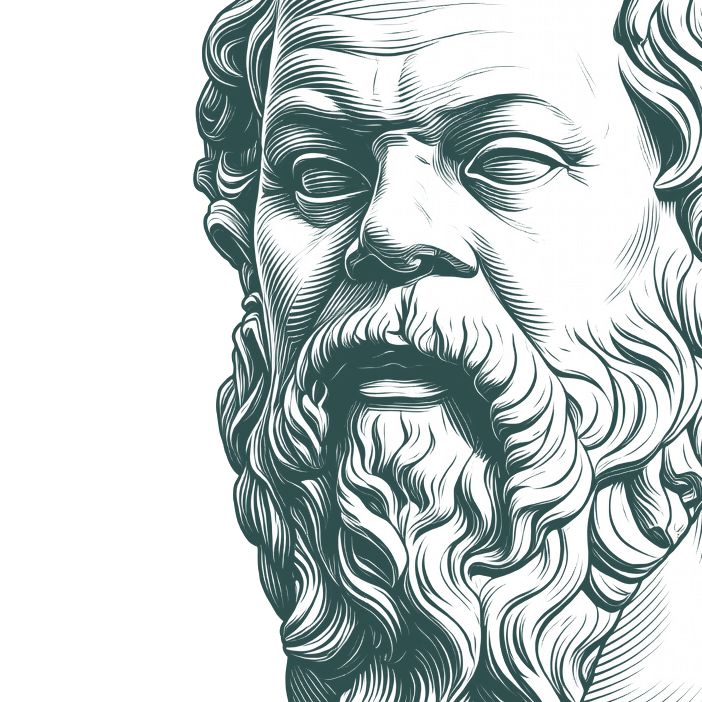
Bio from: Wikiquote (CC BY-SA 4.0) · Portrait adapted from: Wikimedia Commons, Copy of Lysippos (?) (Public domain / CC0)
Native Name:
Σωκράτης
Alternative Names:
Sokrates
•
Sokratis
From Wikidata (CC0)
Showing quotes in randomized order to avoid selection bias. Click Popular for most popular quotes.
Sócrates dijo a sus amigos: «Algunos de vosotros me habéis dicho: Sócrates, si no se ocupara más que de sus asuntos, seguramente podría escapar a la ira del gobierno. Pero yo no puedo. Una vida aceptada sin reflexión, no merece la pena vivirla. Lo menos que se puede esperar de nosotros es que nos comportemos como hombres.»
How singular is the thing called pleasure, and how curiously related to pain, which might be thought to be the opposite of it; for they never come to a man together, and yet he who pursues either of them is generally compelled to take the other. They are two, and yet they grow together out of one head or stem.
"I pity those reviewers above, and people like them, who ridicule authors like R.A. Boulay and other proponents of similar Ancient Astronaut theories, simply for putting forth so many interesting questions (because that's really what he often throughout openly admits is all he does does) in light of fascinating and thought-provoking references which are all from copious sources.
Some people will perhaps only read the cover and introduction and dismiss it as soon as any little bit of information flies in the face of their beliefs or normalcy biases. Some of those people, I'm sure, are some of the ones who reviewed this book so negatively without any constructive criticism or plausible rebuttal. It's sad to see how programmed and indoctrinated the vast majority of humanity has become to the ills of dogma, indoctrination, unverified status quos and basic ignorance; not to mention the laziness and conformity that results in such acquiescence and lack of critical thinking or lack of information gathering to confirm or debunk something. Too many people just take what's spoon fed to them all their lives and settle for it unquestioningly. For those people I like to offer a great Einstein quote and one of my personal favorites and that is:
"Condemnation without investigation is the highest form of ignorance"
I found this book to be a very interesting gathering of information and collection of obscure and/or remote antiquated information, i.e. biblical, sacred, mythological and otherwise, that we were not exactly taught to us in bible school, or any other public school for that matter. And I am of the school of thought that has been so for intended purposes.
The author clearly cites all his fascinating sources and cross-references them rather plausibly. He organizes the information in a sequential manner that piques ones interest even as he jumps from one set of information to the next. The information, although eclectic as it spans from different cultures and time periods, i
Works in ChatGPT, Claude, or Any AI
Add semantic quote search to your AI assistant via MCP. One command setup.
…money and honour have no attraction for them; good men do not wish to be openly demanding payment for governing and so to get the name of hirelings, nor by secretly helping themselves out of the public revenues to get the name of thieves. And not being ambitious they do not care about honour. Wherefore necessity must be laid upon them, and they must be induced to serve from the fear of punishment. And this, as I imagine, is the reason why the forwardness to take office, instead of waiting to be compelled, has been deemed dishonourable. Now the worst part of the punishment is that he who refuses to rule is liable to be ruled by one who is worse than himself. And the fear of this, as I conceive, induces the good to take office, not because they would, but because they cannot help — not under the idea that they are going to have any benefit or enjoyment themselves, but as a necessity, and because they are not able to commit the task of ruling to any one who is better than themselves, or indeed as good. For there is reason to think that if a city were composed entirely of good men, then to avoid office would be as much an object of contention as to obtain office is at present…