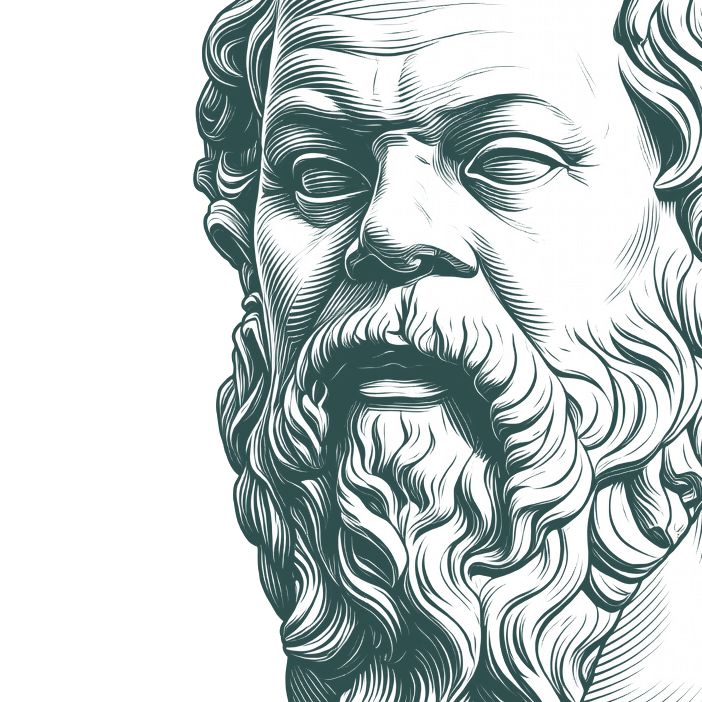
5th-century BCE Greek philosopher
Socrates (Σωκράτης; c. 470 BC – 399 BC) was a classical Greek (Athenian) philosopher credited as one of the founders of Western philosophy. Through his portrayal in Plato's dialogues, Socrates has become renowned for his contribution to the field of ethics, and it is this Platonic Socrates who lends his name to the concepts of Socratic irony and the Socratic method, or elenchus. The latter remains a commonly used tool in a wide range of discussions, and is a type of pedagogy in which a series of questions is asked not only to draw individual answers, but also to encourage fundamental insight into the issue at hand.
Bio from: Wikiquote (CC BY-SA 4.0) · Portrait adapted from: Wikimedia Commons, Copy of Lysippos (?) (Public domain / CC0)
From Wikidata (CC0)
And will he who is a true lover of wisdom, and is persuaded in like manner that only in the world below can he worthily enjoy her, still repine at death? Will he not depart with joy? Surely he will, my friend, if he be a true philosopher. ...And if this be true, he would be very absurd, ...if he were to fear death.
Enhance Your Quote Experience
Enjoy ad-free browsing, unlimited collections, and advanced search features with Premium.
If any man could arrive at the exterior limit, or take the wings of a bird and fly upward, like a fish who puts his head out and sees the world, he would see a world beyond; and, if the nature of man could sustain this sight, he would acknowledge that this was the place of the true heaven and the true light and the true stars. For this earth, and the stones, and the entire region which surrounds us, are spoilt and corroded...
"Suppose... that you acquit me... Suppose that, in view of this, you said to me 'Socrates, on this occasion we shall disregard Anytus and acquit you, but only on one condition, that you give up spending your time on this quest and stop philosophizing. If we catch you going on in the same way, you shall be put to death.' Well, supposing, as I said, that you should offer to acquit me on these terms, I should reply 'Gentlemen, I am your very grateful and devoted servant, but I owe a greater obedience to God than to you; and so long as I draw breath and have my faculties, I shall never stop practicing philosophy and exhorting you and elucidating the truth for everyone that I meet. I shall go on saying, in my usual way, "My very good friend, you are an Athenian and belong to a city which is the greatest and most famous in the world for its wisdom and strength. Are you not ashamed that you give your attention to acquiring as much money as possible, and similarly with reputation and honour, and give no attention or thought to truth and understanding and the perfection of your soul?" And if any of you disputes this and professes to care about these things, I shall not at once let him go or leave him; no, I shall question him and examine him and test him; and if it appears that in spite of his profession he has made no real progress towards goodness, I shall reprove him for neglecting what is of supreme importance, and giving his attention to trivialities. I shall do this to everyone that I meet, young or old, foreigner or fellow-citizen; but especially to you my fellow-citizens, inasmuch as you are closer to me in kinship. This, I do assure you, is what my God commands; and it is my belief that no greater good has ever befallen you in this city than my service to my God; for I spend all my time going about trying to persuade you, young and old, to make your first and chief concern not for your bodies nor for your possessions, but for the highest welfare of your souls, procl
Enhance Your Quote Experience
Enjoy ad-free browsing, unlimited collections, and advanced search features with Premium.
And a thing is not seen because it is visible, but
conversely, visible because it is seen; nor is a thing led because
it is in the state of being led, or carried because it is in the
state of being carried, but the converse of this. And now I think, Euthyphro, that my meaning will be intelligible; and my
meaning is, that any state of action or passion implies previous
action or passion. It does not become because it is becoming,
but it is in a state of becoming because it becomes; neither
does it suffer because it is in a state of suffering, but it is in a
state of suffering because it suffers. Do you not agree?