5th-century BCE Greek philosopher
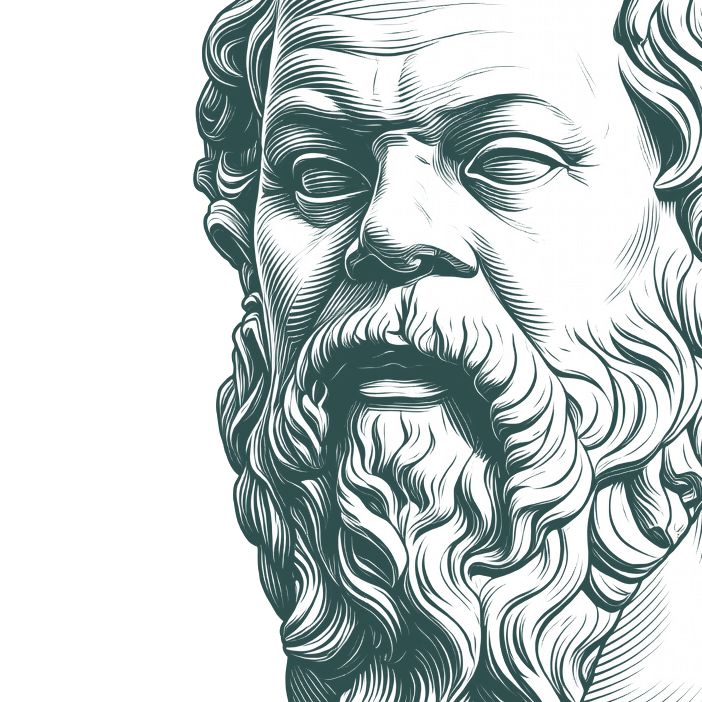
Socrates (Σωκράτης; c. 470 BC – 399 BC) was a classical Greek (Athenian) philosopher credited as one of the founders of Western philosophy. Through his portrayal in Plato's dialogues, Socrates has become renowned for his contribution to the field of ethics, and it is this Platonic Socrates who lends his name to the concepts of Socratic irony and the Socratic method, or elenchus. The latter remains a commonly used tool in a wide range of discussions, and is a type of pedagogy in which a series of questions is asked not only to draw individual answers, but also to encourage fundamental insight into the issue at hand.
Bio from: Wikiquote (CC BY-SA 4.0) · Portrait adapted from: Wikimedia Commons, Copy of Lysippos (?) (Public domain / CC0)
From Wikidata (CC0)
Esteemed friend, citizen of Athens, the greatest city in the world, so outstanding in both intelligence and power, aren't you ashamed to care so much to make all the money you can, and to advance your reputation and prestige — while for truth and wisdom and the improvement of your soul you have no care or worry?
As there are misanthropists, or haters of men, there are also misologists or haters of ideas, and both spring from the same cause, which is ignorance of the world. Misanthropy arises from too great confidence of inexperience; you trust a man and think him altogether true and good and faithful, and then in a little while he turns out to be false and knavish; and then another and another, and when this has happened several times to a man, especially within the circle of his most trusted friends, as he deems them, and he has often quarreled with them, he at last hates all men, and believes that no one has any good in him at all. ...The reason is that a man, having to deal with other men, has no knowledge of them; for if he had knowledge he would have known the true state of the case, that few are the good and few the evil, and that the great majority are in the interval between them.
Let us reflect in another way, and we shall see that there is great reason to hope that death is a good; for one of two things — either death is a state of nothingness and utter unconsciousness, or, as men say, there is a change and migration of the soul from this world to another. Now if you suppose that there is no consciousness, but a sleep like the sleep of him who is undisturbed even by dreams, death will be an unspeakable gain. For if a person were to select the night in which his sleep was undisturbed even by dreams, and were to compare with this the other days and nights of his life, and then were to tell us how many days and nights he had passed in the course of his life better and more pleasantly than this one, I think that any man, I will not say a private man, but even the great king will not find many such days or nights, when compared with the others. Now if death be of such a nature, I say that to die is gain; for eternity is then only a single night. But if death is the journey to another place, and there, as men say, all the dead abide, what good, O my friends and judges, can be greater than this? If indeed when the pilgrim arrives in the world below, he is delivered from the professors of justice in this world, and finds the true judges who are said to give judgment there, Minos and Rhadamanthus and Aeacus and Triptolemus, and other sons of God who were righteous in their own life, that pilgrimage will be worth making. What would not a man give if he might converse with Orpheus and Musaeus and Hesiod and Homer? Nay, if this be true, let me die again and again.
And are not the temperate exactly in the same case? They are temperate because they are intemperate—which may seem to be a contradiction, but is nevertheless the sort of thing which happens with this foolish temperance. For there are pleasures which they must have, and are afraid of losing; and therefore they abstain from one class of pleasures because they are overcome by another: and whereas intemperance is defined as "being under the domination of pleasure," they overcome only because they are overcome by pleasure.
Order and discipline are the most important things in an army, and without them it is impossible to have any other service of the troops than of a confused heap of stones, bricks, timber, and tiles; but when everything is in its due place, as in a building, when the foundations and the covering are made of materials that will not grow rotten, and which no wet can damage, such as are stones and tiles, and when the bricks and timber are employed in their due places in the body of the edifice, they altogether make a house, which we value among our most considerable enjoyments.
Enhance Your Quote Experience
Enjoy ad-free browsing, unlimited collections, and advanced search features with Premium.
Those also who are remarkable for having led holy lives are released from this earthly prison, and go to their pure home which is above, and dwell in the purer earth; and those who have duly purified themselves with philosophy live henceforth altogether without the body, in mansions fairer far than these...
Pero no es difícil, varones, huir de la muerte; muy más difícil es huir de la maldad, que corre más veloz que la muerte. Yo ahora, por tardo y por viejo, seguramente, he sido cogido por lo más lento, mientras que mis acusadores, por hábiles y por vivos, han sido cogidos por lo más veloz: por la maldad