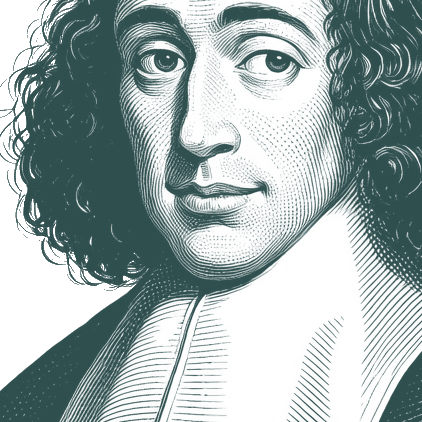
Benedictus de Spinoza (24 November 1632 – 21 February 1677) was a social and metaphysical philosopher known for the elaborate development of his monist philosophy, which has become known as Spinozism. Controversy regarding his ideas led to his excommunication from the Jewish community of his native Amsterdam. He was named Baruch ("blessed" in Hebrew) Spinoza by his synagogue elders and known as Bento de Spinoza or Bento d'Espiñoza, but afterwards used the name Benedictus ("blessed" in Latin) de Spinoza.
Native Name:
בָּרוּךְ שְׂפִּינוֹזָה
•
Benedito de Espinosa
Alternative Names:
Benedict de Spinoza
•
Baruch de Espinosa
•
Barukh Shpinozah
•
Benoît de Spinoza
•
Sbīnūzā
•
Ispīnūzā
•
Barukh Spinoza
•
Bento de Espinosa
•
Baruch d' Espinoza
•
Shpinozah
•
Baruch de Spinoza
•
Spinoza
•
Benoit de Spinoza
•
Benedictus De Spinoza
•
Benedictus Spinoza
•
Baruch Spinoza
•
Baruch Benedictus de Spinoza
To us it seems that this difference, which Spinoza's thought constitutes in the history of Western metaphysics, represents an extremely high point of the theoretical development of modern thought. In other words, Spinoza's thought seems to us to represent a strategy for superseding the antinomies of bourgeois thought. But because bourgeois ideology is essentially based on antinomies, this supersession is a supersession tout court of the ideology. Spinoza gives us being in its immediateness. He destroys the homology between the mediations of articulations of being and the mediations and articulations of bourgeois Power. He presents us with the world as a territory of a joyous construction of immediate human needs.
He who has a true idea simultaneously knows that he has a true idea, and cannot doubt of the truth of the thing perceived.
Enhance Your Quote Experience
Enjoy ad-free browsing, unlimited collections, and advanced search features with Premium.
Blinded as we all are with the "French" Spinoza in all his different guises, from Althusser through Deleuze to Negri, one should not forget other readings of Spinoza which played a crucial role in theoretical orientations whose very mention gives shudder to "postmodern" Leftists. First, Spinoza was a crucial reference in the work of Georgi Plekhanov, the key theoretical figure of Russian Social Democracy, who, a century ago, was the first to evelate Marxism into an all-encompassing world-view (incidentally, he also coined the term "dialectical materialism) - against Hegel, he designated Marxism as "modern Spinozism"... Then, the reference to Spinoza is central for the work of Leo Strauss, the father figure of today's US neo-conservatives: for Strauss, Spinoza provides a model for the split between popular ideology appropriate for ordinary people and true knowledge that should remain accessible only to the few. Last but not least, Spinoza's anti-Cartesian teaching on the human soul is considered an authority among some most influential of today's cognitivists and brain scientists - Antonio Damasio even wrote a popular book Looking for Spinoza. It is thus as if every postmodern "French" figure of Spinoza is accompanied by an obscene disavowed double or precursor: Althusser's proto-Marxist Spinoza - "with Plekhanov"; Negri's anti-Empire Spinoza of the multitude - "with Leo Strauss"; Deleuze's Spinoza of affects - "with Damasio"...