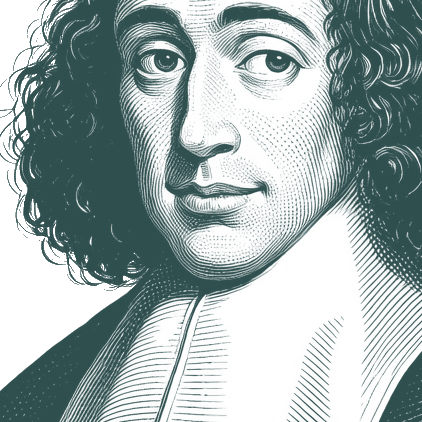
To sum it up in a word: Marx was close to Hegel in his insistence on rejecting every philosophy of the Origin and of the Subject, whether rationalist… - Benedictus de Spinoza
""
To sum it up in a word: Marx was close to Hegel in his insistence on rejecting every philosophy of the Origin and of the Subject, whether rationalist, empiricist or transcendental; in his critique of the cogito, of the sensualist-empiricist subject and of the transcendental subject, thus in his critique of the idea of a theory of knowledge. Marx was close to Hegel in his critique of the legal subject and of the social contract, in his critique of the moral subject, in short of every philosophical ideology of the Subject, which whatever the variation involved gave classical bourgeois philosophy the means of guaranteeing its ideas, practices and goals by not simply reproducing but philosophically elaborating the notions of the dominant legal ideology. And if you consider the grouping of these critical themes, you have to admit that Marx was close to Hegel just in respect to those features which Hegel had openly borrowed from Spinoza, because all this can be found in the Ethics and the Tractatus Theologico-Politicus. These deep-rooted affinities are normally passed over in pious silence; they nevertheless constitute, from Epicurus to Spinoza and Hegel, the premises of Marx's materialism. They are hardly ever mentioned, for the simple reason that Marx himself did not mention them, and so the whole of the Marx-Hegel relationship is made to hang on the dialectic, because this Marx did talk about!
English
Collect this quote
About
Benedictus de Spinoza
Benedictus de Spinoza (24 November 1632 – 21 February 1677) was a social and metaphysical philosopher known for the elaborate development of his monist philosophy, which has become known as Spinozism. Controversy regarding his ideas led to his excommunication from the Jewish community of his native Amsterdam. He was named Baruch ("blessed" in Hebrew) Spinoza by his synagogue elders and known as Bento de Spinoza or Bento d'Espiñoza, but afterwards used the name Benedictus ("blessed" in Latin) de Spinoza.
Native Name:
בָּרוּךְ שְׂפִּינוֹזָה
•
Benedito de Espinosa
Alternative Names:
Benedict de Spinoza
•
Baruch de Espinosa
•
Barukh Shpinozah
•
Benoît de Spinoza
•
Sbīnūzā
•
Ispīnūzā
•
Barukh Spinoza
•
Bento de Espinosa
•
Baruch d' Espinoza
•
Shpinozah
•
Baruch de Spinoza
•
Spinoza
•
Benoit de Spinoza
•
Benedictus De Spinoza
•
Benedictus Spinoza
•
Baruch Spinoza
•
Baruch Benedictus de Spinoza
Philosophers conceive of the passions which harass us as vices into which men fall by their own fault, and, therefore, generally deride, bewail, or blame them, or execrate them, if they wish to seem unusually pious. And so they think they are doing something wonderful, and reaching the pinnacle of learning, when they are clever enough to bestow manifold praise on such human nature, as is nowhere to be found, and to make verbal attacks on that which, in fact, exists. For they conceive of men, not as they are, but as they themselves would like them to be. Whence it has come to pass that, instead of ethics, they have generally written satire, and that they have never conceived a theory of politics, which could be turned to use, but such as might be taken for a chimera, or might have been formed in Utopia, or in that golden age of the poets when, to be sure, there was least need of it. Accordingly, as in all sciences, which have a useful application, so especially in that of politics, theory is supposed to be at variance with practice ; and no men are esteemed less fit to direct public affairs than theorists or philosophers.
Los peores tiranos son aquellos que saben hacerse amar.
Works in ChatGPT, Claude, or Any AI
Add semantic quote search to your AI assistant via MCP. One command setup.