You cannot choose between party government and Parliamentary government. I say, you can have no Parliamentary government if you have no party government; and, therefore, when Gentlemen denounce party government, they strike at that scheme of government which, in my opinion, has made this country great, and which I hope will keep it great.
British statesman (1804–1881)
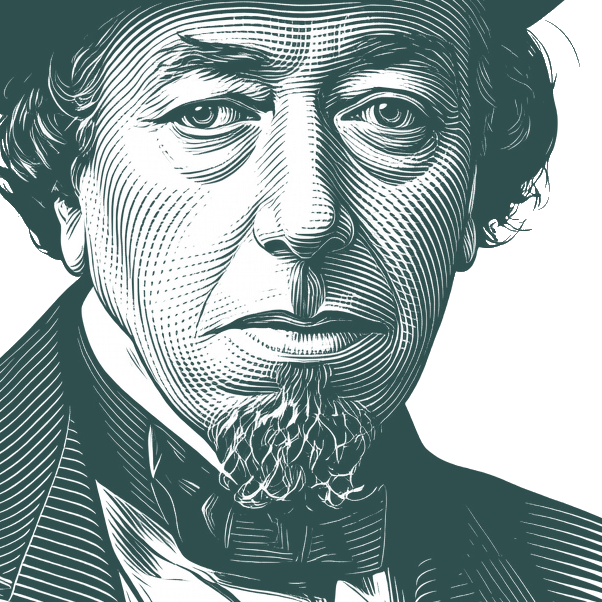
Benjamin Disraeli, 1st Earl of Beaconsfield (21 December 1804 – 19 April 1881) was a British politician, novelist, and essayist, serving twice as Prime Minister of the United Kingdom. The anniversary of his death on 19 April is known as Primrose Day.
Bio from: Wikiquote (CC BY-SA 4.0) · Portrait adapted from: Wikimedia Commons, Cornelius Jabez Hughes (Public domain / CC0)
Birth Name:
Benjamin D'Israeli
Alternative Names:
1st Earl of Beaconsfield Benjamin Disraeli
•
Benjamin, Earl of Beaconsfield Disraeli
•
Benjamin Disraeli, Earl of Beaconsfield
•
Benjamin, Earl of Beaconsfield, Viscount Hughenden of Hughenden Disraeli
•
Dizzy
•
Lord Beaconsfield
From Wikidata (CC0)

The hon. Gentleman has said, in a most extraordinary manner, that our security for peace at the present day is the desire of nations to keep at home. There is a great difference between nationality and race. Nationality is the principle of political independence. Race is the principle of physical analogy, and you have at this moment the principle of race—not at all of nationality—adopted by Germany, the very country to which the hon. Member for the West Riding referred.
Enhance Your Quote Experience
Enjoy ad-free browsing, unlimited collections, and advanced search features with Premium.
As it is not the interest of the rich and the powerful to pursue popular principles of government, the wisdom of great men and the experience of ages have taken care that these principles should be cherished and perpetuated in the form of institutions. Thus, the majesty that guards the multitude is embodied in a throne; the faith that consoles them hovers round the altar of a national Church; the spirit of discussion which is the root of public liberty flourishes in the atmosphere of a free Parliament. But, instead of royalty, a gentleman of Liberal opinions would prefer that the supreme executive should be entrusted to a person of his own class, with the title of a President, and perhaps to have the chance of becoming President himself; instead of a national Church he prefers to choose and pay for his own minister of religion, if he has a wish for one; and although he is not adverse to the theory of representative government, provided the representation is absorbed by his own order, he encourages the real transaction of affairs to be conducted by paid commissioners and select committees. Against these opinions I have ever struggled; I believe that under them all national greatness must wither.
Liberal opinions are the opinions of those who would be free from certain constraints and regulations, from a certain dependence and duty which are deemed necessary for the general or popular welfare. Liberal opinions are very convenient opinions for the rich and powerful. They ensure enjoyment and are opposed to self-sacrifice. The holder of Liberal opinions, for example, maintains that the possession of land is to be considered in a commercial light and no other. He looks to the income which it will afford him. It is not a Liberal opinion that the holder of land should incur the duty of executing justice and maintaining truth among the multitude for nothing. That, gentleman, is a popular principle, a principle of government for the benefit of the people, not a Liberal opinion. A poor law is also founded upon a popular principle; Liberal opinions are entirely adverse to its enactments.
It is unnecessary for me to state that I shall support all those measures, the object of which is to elevate the moral and social condition of the Working Classes, by lessening their hours of toil—by improving their means of health—and by cultivating their intelligence. These are objects which, it is not unpleasing for me to remember, I endeavoured, in common with some of my friends, to advance, before they engaged the attention of Governments, or were supported by triumphant Parliamentary majorities.
In the great struggle between popular principles and liberal opinions, which is the characteristic of our age, I hope ever to be found on the side of the people, and of the Institutions, of England. It is our Institutions that have made us free, and can alone keep us so; by the bulwark which they offer to the insidious encroachments of a convenient, yet enervating, system of centralisation, which, if left unchecked, will prove fatal to the national character.
I have that confidence in the common sense, I will say the common spirit of our countrymen, that I believe they will not long endure this huckstering tyranny of the Treasury Bench—these political pedlars that bought their party in the cheapest market, and sold us in the dearest. I know, Sir, that there are many who believe that the time is gone by when one can appeal to those high and honest impulses that were once the mainstay and the main element of the English character. I know, Sir, that we appeal to a people debauched by public gambling—stimulated and encouraged by an inefficient and shortsighted Minister. I know that the public mind is polluted with economic fancies; a depraved desire that the rich may become richer without the interference of industry and toil. I know, Sir, that all confidence in public men is lost. But, Sir, I have faith in the primitive and enduring elements of the English character. It may be vain now, in the midnight of their intoxication, to tell them that there will be an awakening of bitterness; it may be idle now, in the spring-tide of their economic frenzy, to warn them that there may be an ebb of trouble. But the dark and inevitable hour will arrive. Then, when their spirit is softened by misfortune, they will recur to those principles that made England great, and which, in our belief, can alone keep England great. Then, too, perchance they may remember, not with unkindness, those who, betrayed and deserted, were neither ashamed nor afraid to struggle for the "good old cause"—the cause with which are associated principles the most popular, sentiments the most entirely national—the cause of labour—the cause of the people—the cause of England.
I say, then, assuming, as I have given you reason to assume, that the price of wheat, when this system is established, ranges in England at 35s. per quarter, and other grain in proportion, this is not a question of rent, but it is a question of displacing the labour of England that produces corn, in order, on an extensive and even universal scale, to permit the entrance into this country of foreign corn produced by foreign labour. Will that displaced labour find new employment? ... But what are the resources of this kind of industry to employ and support the people, supposing the great depression in agricultural produce occur which is feared—that this great revolution, as it has appropriately been called, takes place—that we cease to be an agricultural people—what are the resources that would furnish employment to two-thirds of the subverted agricultural population—in fact, from 3,500,000 to 4,000,000 of people? Assume that the workshop of the world principle is carried into effect—assume that the attempt is made to maintain your system, both financial and domestic, on the resources of the cotton trade—assume that, in spite of hostile tariffs, that already gigantic industry is doubled...you would only find increased employment for 300,000 of your population...What must be the consequence? I think we have pretty good grounds for anticipating social misery and political disaster.
Unlimited Quote Collections
Organize your favorite quotes without limits. Create themed collections for every occasion with Premium.
First, without reference to England, looking at all countries, I say that it is the first duty of the Minister, and the first interest of the State, to maintain a balance between the two great branches of national industry; that is a principle which has been recognised by all great Ministers for the last two hundred years...Why we should maintain that balance between the two great branches of national industry, involves political considerations—social considerations, affecting the happiness, prosperity, and morality of the people, as well as the stability of the State. But I go further; I say that in England we are bound to do more—I repeat what I have repeated before, that in this country there are special reasons why we should not only maintain the balance between the two branches of our national industry, but why we should give a preponderance...to the agricultural branch; and the reason is, because in England we have a territorial Constitution. We have thrown upon the land the revenues of the Church, the administration of justice, and the estate of the poor; and this has been done, not to gratify the pride, or pamper the luxury of the proprietors of the land, but because, in a territorial Constitution, you, and those whom you have succeeded, have found the only security for self-government—the only barrier against that centralising system which has taken root in other countries.