French novelist, critic and essayist (1871–1922)
Valentin Louis Georges Eugène Marcel Proust (10 July 1871 – 18 November 1922) was a French novelist, essayist and critic.
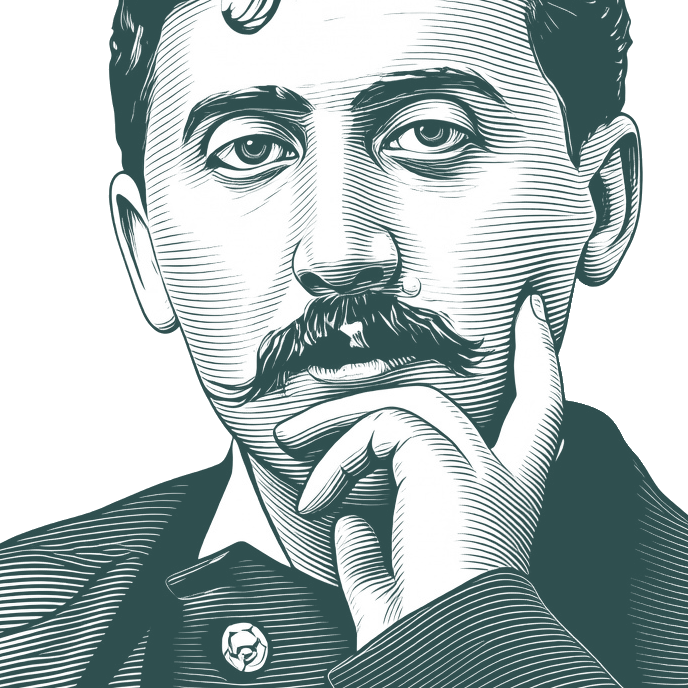
Bio from: Wikiquote (CC BY-SA 4.0) · Portrait adapted from: Wikimedia Commons, Otto Wegener (Public domain / CC0)
From Wikidata (CC0)

We passionately long for there to be another life in which we shall be similar to what we are here below. But we do not pause to reflect that, even without waiting for that other life, in this life, after a few years, we are unfaithful to what we once were, to what we wished to remain immortally. Even without supposing that death is to alter us more completely than the changes that occur in the course of our lives, if in that other life we were to encounter the self that we have been, we should turn away from ourselves as from those people with whom we were once on friendly terms but whom we have not seen for years… We dream much of a paradise, or rather of a number of successive paradises, but each of them is, long before we die, a paradise lost, in which we should feel ourselves lost too.
I thought nothing at all, but I felt an immense sadness, as when two parts of one’s past existence, which have been anchored near to one, and upon which one has perhaps been basing idly from day to day an unacknowledged hope, remove themselves finally, with a joyous flapping of pennants, for unknown destinations, like a pair of ships.
The name Gilberte passed close by me, evoking all the more forcibly her whom it labelled in that it did not merely refer to her, as one speaks of a man in his absence, but was directly addressed to her; it passed thus close by me, in action, so to speak, with a force that increased with the curve of its trajectory and as it drew near to its target; — carrying in its wake, I could feel, the knowledge, the impression of her to whom it was addressed that belonged not to me but to the friend who called to her, everything that, while she uttered the words, she more or less vividly reviewed, possessed in her memory, of their daily intimacy, of the visits that they paid to each other, of that unknown existence which was all the more inaccessible, all the more painful to me from being, conversely, so familiar, so tractable to this happy girl who let her message brush past me without my being able to penetrate its surface, who flung it on the air with a light-hearted cry: letting float in the atmosphere the delicious attar which that message had distilled, by touching them with precision, from certain invisible points in Mlle. Swann's life, from the evening to come, as it would be, after dinner, at her home, — forming, on its celestial passage through the midst of the children and their nursemaids, a little cloud, exquisitely coloured, like the cloud that, curling over one of Poussin's gardens, reflects minutely, like a cloud in the opera, teeming with chariots and horses, some apparition of the life of the gods; casting, finally, on that ragged grass, at the spot on which she stood [....]
the Celtic belief that the souls of those whom we have lost are held captive in some inferior being, in an animal, in a plant, in some inanimate object and so effectively lost to us until the day (which to many never comes) when we happen to pass by the tree or to obtain possession of the object which forms their prison. Then they start and tremble, they call us by our name, and as soon as we have recognized their voices the spell is broken. We have delivered them: they have overcome death and return to share our life.
Poets claim that we recapture for a moment the self that we were long ago when we enter some house or garden in which we used to live in our youth. But these are most hazardous pilgrimages, which end as often in disappointment as in success. It is in ourselves that we should rather seek to find those fixed places, contemporaneous with different years. And great fatigue followed by a good night's rest can to a certain extent help us to do so. For in order to make us descend into the most subterranean galleries of sleep, where no reflexion from overnight, no gleam of memory comes to light up the interior monologue — if the latter does not itself cease — fatigue followed by rest will so thoroughly turn over the soil and penetrate the bedrock of our bodies that we discover down there, where our muscles plunge and twist in their ramifications and breathe in new life, the garden where we played in our childhood. There is no need to travel in order to see it again; we must dig down inwardly to discover it. What once covered the earth is no longer above but beneath it; a mere excursion does not suffice for a visit to the dead city: excavation is necessary also. But we shall see how certain fugitive and fortuitous impressions carry us back even more effectively to the past, with a more delicate precision, with a more light-winged, more immaterial, more headlong, more unerring, more immortal flight, than these organic dislocations.
Try QuoteGPT
Chat naturally about what you need. Each answer links back to real quotes with citations.
You won’t manage, you’ll forget me; but if after a year, alas, more perhaps, a sad text, a death, or a rainy evening reminds you of me, you can offer me some altruism! I will never, never be able see you again . . . except in my soul, and this would require that we think about each other simultaneously. I’ll think about you forever so that my soul remains open to you endlessly in case you feel like entering it. But the visitor will keep me waiting for a long time! The November rains will have rotted the flowers on my grave, June will have burned them, and my soul will always be weeping impatiently. Ah! I hope that someday the sight of a keepsake, the recurrence of a birthday, the bent of your thoughts will guide your memory within the circle of my tenderness. It will then be as if I’ve heard you, perceived you, a magic spell will cover everything with flowers for your arrival. Think about the dead man. But, alas! Can I hope that death and your gravity will accomplish what life with its ardors, and our tears, and our merry times, and our lips were unable to achieve?
"This torture inflicted on her by my great-aunt, the sight of my grandmother's vain entreaties, of her feeble attempts, doomed in advance, to remove the liqueur-glass from my grandfather's hands — all these were things of the sort to which, in later years, one can grow so accustomed as to smile at them and to take the persecutor's side resolutely and cheerfully enough to persuade oneself that it is not really persecution; but in those days they filled me with such horror that I longed to strike my great-aunt. And yet, as soon as I heard her "Bathilde! Come in and stop your husband drinking brandy," in my cowardice I became at once a man, and did what all we grown men do when face to face with suffering and injustice: I preferred not to see them."
When we are in love, our love is too big a thing for us to be able altogether to contain it within ourselves. It radiates towards the loved one, finds there a surface which arrests it, forcing it to return to its starting-point, and it is this repercussion of our own feeling which we call the other's feelings and which charms us more then than on its outward journey because we do not recognise it as having originated in ourselves.