From a comparative perspective, the United States is unusual if not unique in the lack of restraints on freedom of expression. It is also unusual in the range and effectiveness of methods employed to restrain freedom of thought... Where the voice of the people is heard, elite groups must insure their voice says the right things... The less the state is able to employ violence in the defense of the interest of the elite groups that effectively dominate it, the more it becomes necessary to devise techniques of ‘manufacture of consent’... Where obedience is guaranteed by violence, rulers may tend towards a ‘behaviourist’ conception; it is enough that people obey; what they think does not matter too much. Where the state lacks means of coercion, it is important to control what people think.
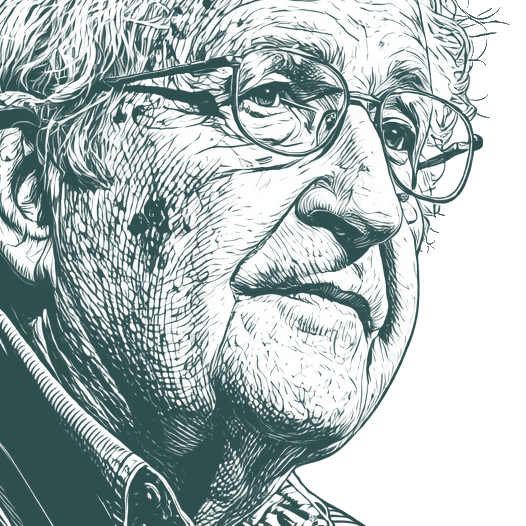
American linguist and activist (born 1928)
Avram Noam Chomsky (born 7 December 1928) is an American linguist, analytical philosopher, cognitive scientist, political analyst, human rights activist and anarcho-socialist.
Bio from: Wikiquote (CC BY-SA 4.0) · Portrait adapted from: Wikimedia Commons, Augusto Starita / Ministerio de Cultura de la Nación (CC BY-SA)
Birth Name:
Avram Noam Chomsky
Alternative Names:
A. Noam Chomsky
•
Chomsky
From Wikidata (CC0)
Showing quotes in randomized order to avoid selection bias. Click Popular for most popular quotes.
Some time ago I was asked to sign a petition in defense of Robert Faurisson's “freedom of speech and expression.” The petition said absolutely nothing about the character, quality or validity of his research, but restricted itself quite explicitly to a defense of elementary rights that are taken for granted in democratic societies, calling upon university and government officials to “do everything possible to ensure the [Faurisson’s] safety and the free exercise of his legal rights.” I signed it without hesitation.
Take the United States today, it is living under a kind of totalitarian culture which has never existed in my lifetime and is much worse in many ways than the Soviet Union before Gorbachev. Go back to the 1970s. People in Soviet Russia could access BBC, Voice of America, German Television, if they wanted to find out the news. If today, in the United States, you want to find out what Prime Minister Lavrov of Russia is saying, can't do it. It's barred. Americans are not permitted to hear what Russians are saying. Can’t get Russian television, can’t access Russian sources. That means also that fine American journalists like Chris Hedges, one of the best, is cut out, barred from Americans, because he happens to have a program running on RT…. the United States has imposed constraints on freedom of access to information which are astonishing and, which in fact, go beyond what was the case in post-Stalin Soviet Russia. That’s just a remarkable fact…. Anyone who dares to break the party line on the dominant issue of today, Ukraine, is simply demonized, vilified. Can’t be sent to the gulag— free country, still— but you can barely talk…
There are growing domestic social and economic problems, in fact, maybe catastrophes. Nobody in power has any intention of doing anything about them. If you look at the domestic programs of the administrations of the past ten years-I include here the Democratic opposition-there's really no serious proposal about what to do about the severe problems of health, education, homelessness, joblessness, crime, soaring criminal populations, jails, deterioration in the inner cities - the whole raft of problems... In such circumstances you've got to divert the bewildered herd, because if they start noticing this they may not like it, since they're the ones suffering from it. Just having them watch the Superbowl and the sitcoms may not be enough. You have to whip them up into fear of enemies. In the 1930s Hitler whipped them into fear of the Jews and gypsies. You had to crush them to defend yourselves. We have our ways, too. Over the last ten years, every year ot two, some major monster is constructed that we have to defend ourselves against.
Take the Kyoto Protocol. Destruction of the environment is not only rational; it's exactly what you're taught to do in college. If you take an economics or a political science course, you're taught that humans are supposed to be rational wealth accumulators, each acting as an individual to maximize his own wealth in the market. The market is regarded as democratic because everybody has a vote. Of course, some have more votes than others because your votes depend on the number of dollars you have, but everybody participates and therefore it's called democratic. Well, suppose that we believe what we are taught. It follows that if there are dollars to be made, you destroy the environment. The reason is elementary. The people who are going to be harmed by this are your grandchildren, and they don't have any votes in the market. Their interests are worth zero. Anybody that pays attention to their grandchildren's interests is being irrational, because what you're supposed to do is maximize your own interests, measured by wealth, right now. Nothing else matters. So destroying the environment and militarizing outer space are rational policies, but within a framework of institutional lunacy. If you accept the institutional lunacy, then the policies are rational.
Works in ChatGPT, Claude, or Any AI
Add semantic quote search to your AI assistant via MCP. One command setup.
One reason that propaganda often works better on the educated than on the uneducated is that educated people read more, so they receive more propaganda. Another is that they have jobs in management, media, and academia and therefore work in some capacity as agents of the propaganda system--and they believe what the system expects them to believe. By and large, they're part of the privileged elite, and share the interests and perceptions of those in power.
If there was an observer on Mars, they would probably be amazed that we have survived this long. There are two problems for our species' survival - nuclear war and environmental catastrophe - and we're hurtling towards them. Knowingly. This hypothetical Martian would probably conclude that human beings were an evolutionary error.
Yet to enter approved memory is the "finale" described in the official Air Force history, a 1000-plane raid on civilian targets organized by General "Hap" Arnold to celebrate the war's end, five days after Nagasaki. According to survivors, leaflets were dropped among the bombs announcing the surrender.
Enhance Your Quote Experience
Enjoy ad-free browsing, unlimited collections, and advanced search features with Premium.
Our primary concern has been U.S. global policy and propaganda, and the filtering and distorting effect of Western ideology, not the problems of reconstruction and modernization in societies that have been victimized by Western imperialism. Correspondingly, we have not developed or expressed our views here on the nature of the Indochinese regimes. To assess the contemporary situation in Indochina and the programs of the current ruling groups is a worthwhile endeavor, but it has not been our current objective. [...] The success of the Free Press in reconstructing imperial ideology since the U.S. withdrawal has been spectacular. The shift of the United States from causal agent to bystander – and even to leader of the struggle for human rights – in the face of its empire of client fascism and long, vicious assault on the peasant societies of Indochina, is a remarkable achievement. The system of brainwashing under freedom, with mass media voluntary self-censorship in accord with the larger interests of the state, has worked brilliantly.