4th-century BCE Greek philosopher
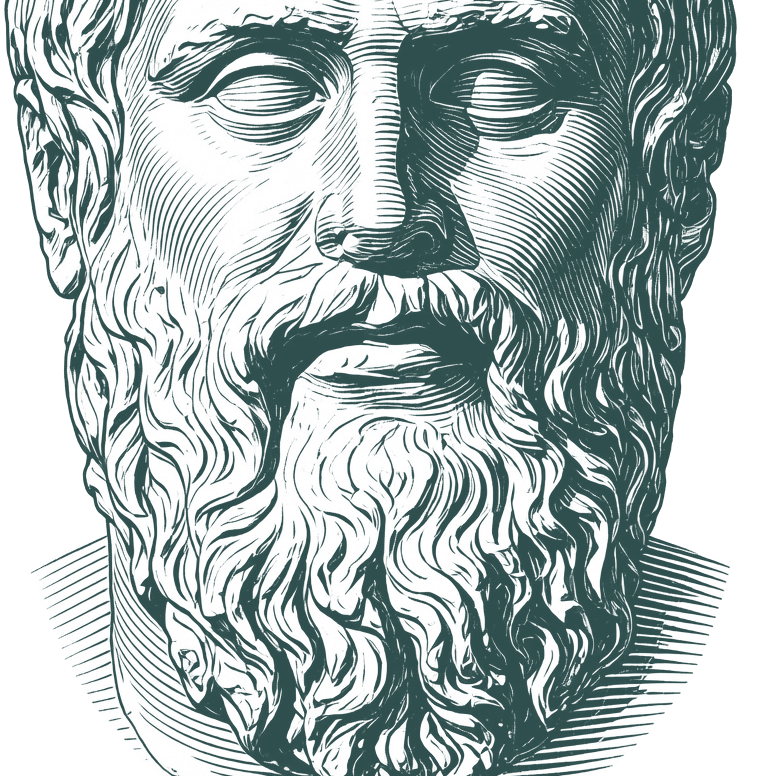
Plato (Πλάτων Plátōn; c. 427 BC – c. 347 BC) was a Greek philosopher from Athens during the Classical period in Ancient Greece, founder of the Platonist school of thought and the Academy (Akademia), the first institution of higher learning in the Western world.
Bio from: Wikiquote (CC BY-SA 4.0) · Portrait adapted from: Wikimedia Commons, Marie-Lan Nguyen (CC BY)
From Wikidata (CC0)
Now in this island of Atlantis there was a great and wonderful empire which had rule over the whole island and several others, and over parts of the continent and, furthermore, the men of Atlantis had subjected the parts of Libya within the columns of Heracles as far as Egypt, and of Europe as far as Tyrrhenia. This vast power, gathered into one, endeavored to subdue at a blow our country and yours and the whole of the region within the straits, and then, Solon, your country shone forth, in the excellence of her virtue and strength, among all mankind.
Whereas, our argument shows that the power and capacity of learning exists in the soul already; and that just as the eye was unable to turn from darkness to light without the whole body, so too the instrument of knowledge can only by the movement of the whole soul be turned from the world of becoming into that of being, and learn by degrees to endure the sight of being, and of the brightest and best of being, or in other words, of the good.
[there are] two kinds of things the nature of which it would be quite wonderful to grasp by means of a systematic art...
the first consists in seeing together things that are scattered about everywhere and collecting them into one kind, so that by defining each thing we can make clear the subject of any instruction we wish to give...
[the second], in turn, is to be able to cut up each kind according to its species along its natural joints, and to try not to splinter any part, as a bad butcher might do...
phaedrus, i myself am a lover of these divisions and collections, so that i may be able to think and to speak.