The worthwhile problems are the ones you can really solve or help solve, the ones you can really contribute something to. … No problem is too small or too trivial if we can really do something about it. <p>You say you are a nameless man. You are not to your wife and to your child. You will not long remain so to your immediate colleagues if you can answer their simple questions when they come into your office. You are not nameless to me. Do not remain nameless to yourself — it is too sad a way to be. Know your place in the world and evaluate yourself fairly, not in terms of the naïve ideals of your own youth, nor in terms of what you erroneously imagine your teacher's ideals are.
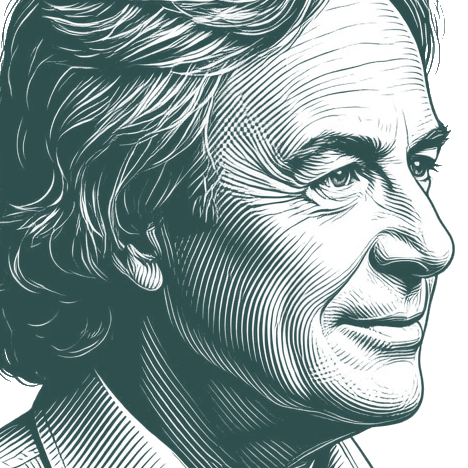
American theoretical physicist (1918–1988)
Richard Phillips Feynman (May 11, 1918 – February 15, 1988) was an American theoretical physicist. He is known for the work he did in the path integral formulation of quantum mechanics, the theory of quantum electrodynamics, the physics of the superfluidity of supercooled liquid helium, and in particle physics, for which he proposed the parton model. For his contributions to the development of quantum electrodynamics, Feynman received the Nobel Prize in Physics in 1965 jointly with Julian Schwinger and Shin'ichirō Tomonaga. Feynman developed a widely used pictorial representation scheme for the mathematical expressions describing the behavior of subatomic particles, which later became known as Feynman diagrams. During his lifetime, Feynman became one of the best-known scientists in the world.
Bio from: Wikiquote (CC BY-SA 4.0) · Portrait adapted from: Wikimedia Commons, Copyright Tamiko Thiel 1984 (CC BY-SA)
Pen Names:
Ofey
Native Name:
Richard Phillips Feynman
Alternative Names:
Feynman
•
Dick Feynman
•
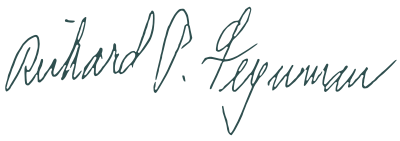
Richard P. Feynman
From Wikidata (CC0)
Showing quotes in randomized order to avoid selection bias. Click Popular for most popular quotes.
I believe, therefore, that although it is not the case today, that there may some day come a time, I should hope, when it will fully appreciated that the power of governments should be limited; that governments ought not to be empowered to decide the validity of scientific theories, that this is a ridiculous thing for them to try to do; that they are not to decide the description of history or of economic theory or of philosophy.
I believe in limited government. I believe that government should be limited in many ways, and what I am going to emphasize is only an intellectual thing. I don't want to talk about everything at the same time. Let's take a small piece, an intellectual thing.<P>No government has the right to decide on the truth of scientific principles, nor to prescribe in any way the character of the questions investigated. Neither may a government determine the aesthetic value of artistic creations, nor limit the forms of literary or artistic expression. Nor should it pronounce on the validity of economic, historic, religious, or philosophical doctrines. Instead it has a duty to its citizens to maintain the freedom, to let those citizens contribute to the further adventure and the development of the human race.
I started to walk into the bar, and I suddenly thought to myself, “Wait a minute! It’s the middle of the afternoon. There’s nobody here. There’s no social reason to drink. Why do you have such a terribly strong feeling that you have to have a drink?” — and I got scared. I never drank ever again, since then. I suppose I really wasn’t in any danger, because I found it very easy to stop. But that strong feeling that I didn’t understand frightened me. You see, I get such fun out of thinking that I don’t want to destroy this most pleasant machine that makes life such a big kick. It’s the same reason that, later on, I was reluctant to try experiments with LSD in spite of my curiosity about hallucinations.
"I took a little walk outside for a while. I was surprised that I wasn't feeling what I thought people were supposed to feel under the circumstances. May be I was fooling myself. I wasn't delighted, but I didn't feel terribly upset, perhaps because we had known for a long time that it was going to happen.
It's hard to explain. If a Martian(who, we'll imagine never dies except by accident) came to Earth and saw this peculiar race of creatures-these humans who live about seventy or eighty years, knowing that death is going to come — it would look to hi like a terrible problem of psychology to live under those circumstances, knowing that life is only temporary Well, we humans somehow figure out how to live despite this problem: we laugh, we joke, we live.
The only difference for me and Arlene was, instead of fifty years, it was five years. It was only a quantitative difference — the psychological problem was just the same. The only way it would have become any different is if we had said to ourselves, "But those other people have it better, because they might live fifty years." But that's crazy. Why make yourself miserable saying things like, "Why do we have such bad luck? What has God done to us? What have we done to deserve this?" — all of which, if you understand reality and take it completely into your heart, are irrelevant and unsolvable. They are just things that nobody can know. Your situation is just an accident of life..
We had a hell of good time together..."
PREMIUM FEATURE
Advanced Search Filters
Filter search results by source, date, and more with our premium search tools.
I went for a walk outside. Maybe I was fooling myself, but I was surprised how I didn’t feel what I thought people would expect to feel under the circumstances. I wasn’t delighted, but I didn’t feel terribly upset, perhaps because I had known for seven years that something like this was going to happen. I didn’t know how I was going to face all my friends up at Los Alamos. I didn’t want people with long faces talking to me about it. When I got back (yet another tire went flat on the way), they asked me what happened. “She’s dead. And how’s the program going?” They caught on right away that I didn’t want to moon over it. (I had obviously done something to myself psychologically: Reality was so important — I had to understand what really happened to Arlene, physiologically — that I didn’t cry until a number of months later, when I was in Oak Ridge. I was walking past a department store with dresses in the window, and I thought Arlene would like one of them. That was too much for me.)
On the contrary, it's because somebody knows something about it that we can't talk about physics. It's the things that nobody knows anything about that we can discuss. We can talk about the weather; we can talk about social problems; we can talk about psychology; we can talk about international finance — gold transfers we can't talk about, because those are understood — so it's the subject that nobody knows anything about that we can all talk about!