A belief is a lever that, once pulled, moves almost everything in a person’s life. Are you a scientist? A liberal? A racist? These are merely species of belief in action. Your beliefs define your vision of the world; they dictate your behavior; they determine your emotional responses to other human beings. If you doubt this, consider how your experience would suddenly change if you came to believe one of the following propositions:
1. You have only two weeks to live.
2. You've just won the lottery prize of one hundred million dollars.
3. Aliens have implanted a receiver in your skull and are manipulating your thoughts.
These are mere words- until you believe them. once believed, they become part of the very apparatus of your mind, determining your desires, fears, expectations, and subsequent behavior.
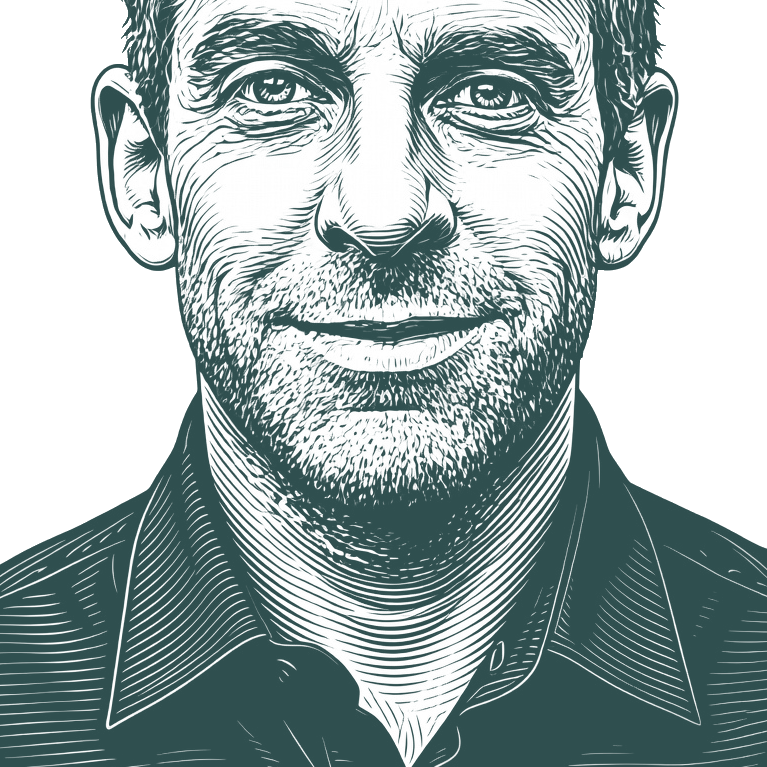
American author, philosopher and neuroscientist (born 1967)
Samuel Benjamin Harris (born April 9, 1967) is an American author, philosopher, public intellectual, and neuroscientist, as well as the co-founder and CEO of Project Reason. He is the author of The End of Faith (2004), which won the PEN/Martha Albrand Award for First Nonfiction in 2005 and appeared on The New York Times best seller list for 33 weeks, Letter to a Christian Nation (2006), The Moral Landscape (2010), Lying (2011), Free Will (2012), and most recently Waking Up: A Guide to Spirituality Without Religion (2014).
Bio from: Wikiquote (CC BY-SA 4.0) · Portrait adapted from: Wikimedia Commons, Cmichel67 (Christopher Michel) (CC BY-SA)
Birth Name:
Samuel Benjamin Harris
Alternative Names:
Samuel Harris
From Wikidata (CC0)

Showing quotes in randomized order to avoid selection bias. Click Popular for most popular quotes.
We are conscious of only a tiny fraction of the information that our brains process in each moment.1 Although we continually notice changes in our experience — in thought, mood, perception, behavior, etc. — we are utterly unaware of the neurophysiological events that produce them. In fact, we can be very poor witnesses to experience itself. By merely glancing at your face or listening to your tone of voice, others are often more aware of your state of mind and motivations than you are.
I generally start each day with a cup of coffee or tea — sometimes two. This morning, it was coffee (two). Why not tea? I am in no position to know. I wanted coffee more than I wanted tea today, and I was free to have what I wanted. Did I consciously choose coffee over tea? No. The choice was made for me by events in my brain that I, as the conscious witness of my thoughts and actions, could not inspect or influence. Could I have “changed my mind” and switched to tea before the coffee drinker in me could get his bearings? Yes, but this impulse would also have been the product of unconscious causes. Why didn’t it arise this morning? Why might it arise in the future? I cannot know. The intention to do one thing and not another does not originate in consciousness — rather, it appears in consciousness, as does any thought or impulse that might oppose it.
The physiologist Benjamin Libet famously used EEG to show that activity in the brain’s motor cortex can be detected some 300 milliseconds before a person feels that he has decided to move.2 Another lab extended this work using functional magnetic resonance imaging (fMRI): Subjects were asked to press one of two buttons while watching a “clock” composed of a random sequence of letters appearing on a screen. They reported which letter was visible at the moment they decided to press one button or the other. The experimenters found two brain regions that contained information about which button subjects would press a full 7 to 10 seconds be
For nearly a century, the moral relativism of science has given faith-based religion — that great engine of ignorance and bigotry — a nearly uncontested claim to being the only universal framework for moral wisdom. As a result, the most powerful societies on early spend their time debating issues like gay marriage when they should be focused on problems like nuclear proliferation, genocide, energy security, climate change, poverty, and failing schools.
The penalty for apostasy is death. We would do well to linger over this fact for a moment, because it is the black pearl of intolerance that no liberal exegesis will ever fully digest.....As a source of objective morality, the Bible is one of the worst books we have. It might be the very worst, in fact—if we didn’t also happen to have the Qur’an.
Unlimited Quote Collections
Organize your favorite quotes without limits. Create themed collections for every occasion with Premium.
If my decision to have a second cup of coffee this morning was due to a random release of neurotransmitters, how could the indeterminacy of the initiating event count as the free exercise of my will? Chance occurrences are by definition ones for which I can claim no responsibility. And if certain of my behaviors are truly the result of chance, they should be surprising even to me. How would neurological ambushes of this kind make me free?
There is never a moment where I find Trump persuasive. When I look at him I see a man without any inner life. I see the most superficial person on Earth. This is a guy who has been totally hollowed out by greed and self regard and delusion. If I caught some sort of brain virus and I started talking about myself the way Trump talks about himself, I would throw myself out a fucking window. That barely overstates it. Do you remember that scene at the end of The Exorcist where the priest is driving out the devil from Linda Blair and the devil comes into him and he just hurls himself out the window to end all the madness? Well, it would be like that.
Science has long been in the value business. Despite a widespread belief to the contrary, scientific validity is not the result of scientists abstaining from making value judgments; rather, scientific validity is the result of scientists making their best efforts to value principles of reasoning that link their beliefs to reality, through reliable chains of evidence and argument. This is how norms of rational thought are made effective... The answer to the question "What should I believe, and why should I believe it?" is generally a scientific one.
The fundamentalist picks up the book and says, “Okay, I’m just going to read every word of this and do my best to understand what God wants from me. I’ll leave my personal biases completely out of it.” Conversely, every moderate seems to believe that his interpretation and selective reading of scripture is more accurate than God’s literal words. Presumably, God could have written these books any way He wanted. And if He wanted them to be understood in the spirit of twenty-first-century secular rationality, He could have left out all those bits about stoning people to death for adultery or witchcraft. It really isn’t hard to write a book that prohibits sexual slavery — you just put in a few lines like “Don’t take sex slaves!” and “When you fight a war and take prisoners, as you inevitably will, don’t rape any of them!” And yet God couldn’t seem to manage it. This is why the approach of a group like the Islamic State holds a certain intellectual appeal (which, admittedly, sounds strange to say) because the most straightforward reading of scripture suggests that Allah advises jihadists to take sex slaves from among the conquered, decapitate their enemies, and so forth.
Integrity consists of many things, but it generally requires us to avoid behavior that readily leads to shame or remorse. The ethical terrain here extends well beyond the question of honesty — but to truly have integrity, we must not feel the need to lie about our personal lives. To lie is to erect a boundary between the truth we are living and the perception others have of us.
Religious moderation, insofar as it represents an attempt to hold on to what is still serviceable in orthodox religion, closes the door to more sophisticated approaches to spirituality, ethics, and the building of strong communities. Religious moderates seem to believe that what we need is not radical insight and innovation in these areas but a mere dilution of Iron Age philosophy.